
Pilgrimage with Dikshitar to Tirukazhukundram
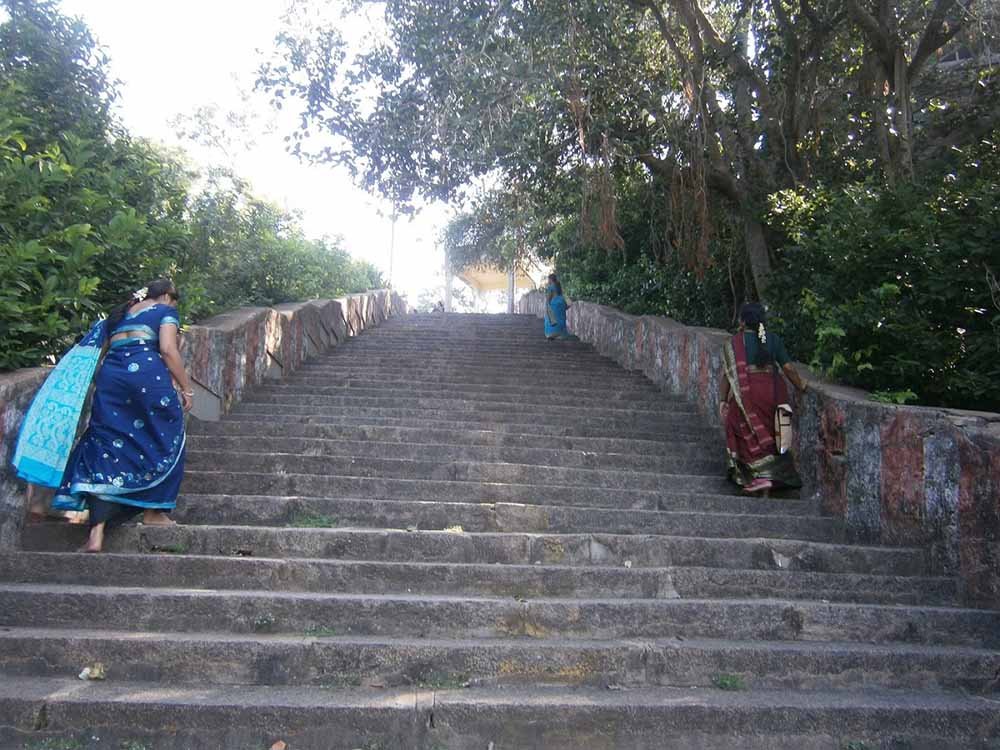
Tirukkazhukkunram is a well-known temple of Shiva, near Chengalpet. The temple is on a hill, requiring around 550 steps to be climbed. Like Tirupati, the Lord is on the hill, while the Goddess is in a temple at the foot of the hill. Tirukkazhukkunram was famous for the pair of eagles which used to come regularly to a particular spot near the temple every afternoon to be fed by the priest.
Muthuswamy Dikshitar has visited this hoary temple and composed “Vedapurishwaram bhajare” in Ragam Dhanyasi , Adi Talam. As is his practice, he has mentioned details of the Sthalam in his lyrics such as the Vedas worshipping the Lord, Goddess Tripurasundari being His consort and Vishnu
and other Devas chanting His praise. This beautiful Kriti, with its phrases laden with meaning and rare Prayogas of Dhanyasi, was learnt by the students of Veenavaadhini over the last few weeks, in preparation for the Yatra to the site where it was composed.
On Saturday, November 17th, we left for Tirukkazhukkunram at around 6.30am from Chennai. Our group comprised of our Gurus Sri Jeyaraaj and Smt Jaysri and their students and a couple of mothers. Since there were many young people, we first had some breakfast before we proceeded to climb the hill. We first sought the blessings of Ganesha who was at the foothill. As could be expected, the children sprinted ahead while the others climbed leisurely. Although the steps were steep, we were rewarded by the lovely emerging views of the nearby temples, tanks, houses, fields and lakes. The weather had been pleasant in the last few days and that day was no exception.
Moreover, the numerous large trees on either side of the steps ensured that we were well protected from the sun. One noticed a large number of Indian Laburnum trees (sara-konrai or Golden Shower) as well as Siamese Cassia (manjal-konrai, Kassod). There were also Neem, Peepul and one big Banyan tree on the way.
The temple on the hill is medium-sized. We waited a few minutes for the Archaka and then went inside the shrine and sang the kritis “Vedapurishwaram bhajare”, “ Tripurasundari” (Saama) and “Vishwanathena”(Saamantha). The Archaka then performed Archana and during the Karpoora-harathi, he showed us the amazing Bas Relief sculptures found in the Sanctum Sanctorum. There was Somaskanda along with an adoring Vishnu behind the Lingam, as well as Dakshinamurthy and Ardhanarishwara with Nandi on the two side walls. (These are features of Pallava architecture.) He also explained the significance of Tirukkazhukkunram – it being sung by all three saint-composers of Thevaaram, as well as being sung by Manickavachakar, Arunagirinathar and Pattinathaar. He rued the fact that due to pollution or other evils of the times, the eagles had stopped coming and asked us to pray that the next generation of eagles starts coming.
After this moving, uplifting experience, we climbed down through a different path. On the way we saw an old cave temple dated to Mahendravarma-I. It has a Lingam and two sizable Dwarapalakas.
We went to an ancient temple of Vishnu in Sadras(Sathurangapattinam). He is known as Malai Mandala Perumal and as Garuda is depicted with eight snakes on his person, this is a Sarpa-dosha Parihara-sthalam. The Panchaloha idol of Anjaneya, from the Vijayanagara time, is the one drawn by the artist Vinu in the famous picture blessed by the Mahaswami of Kanchi. Here too we were fortunate that the Bhattar explained the unique features of the Kshetra to us in detail. We soaked in the quietness and greenery of this small but impressive temple, with a coucal’s sweet calls adding to the experience. After the nice lunch, we returned to Chennai with a sense of elation and gratitude.
REPORT BY RAJANI ARJUN SHANKAR